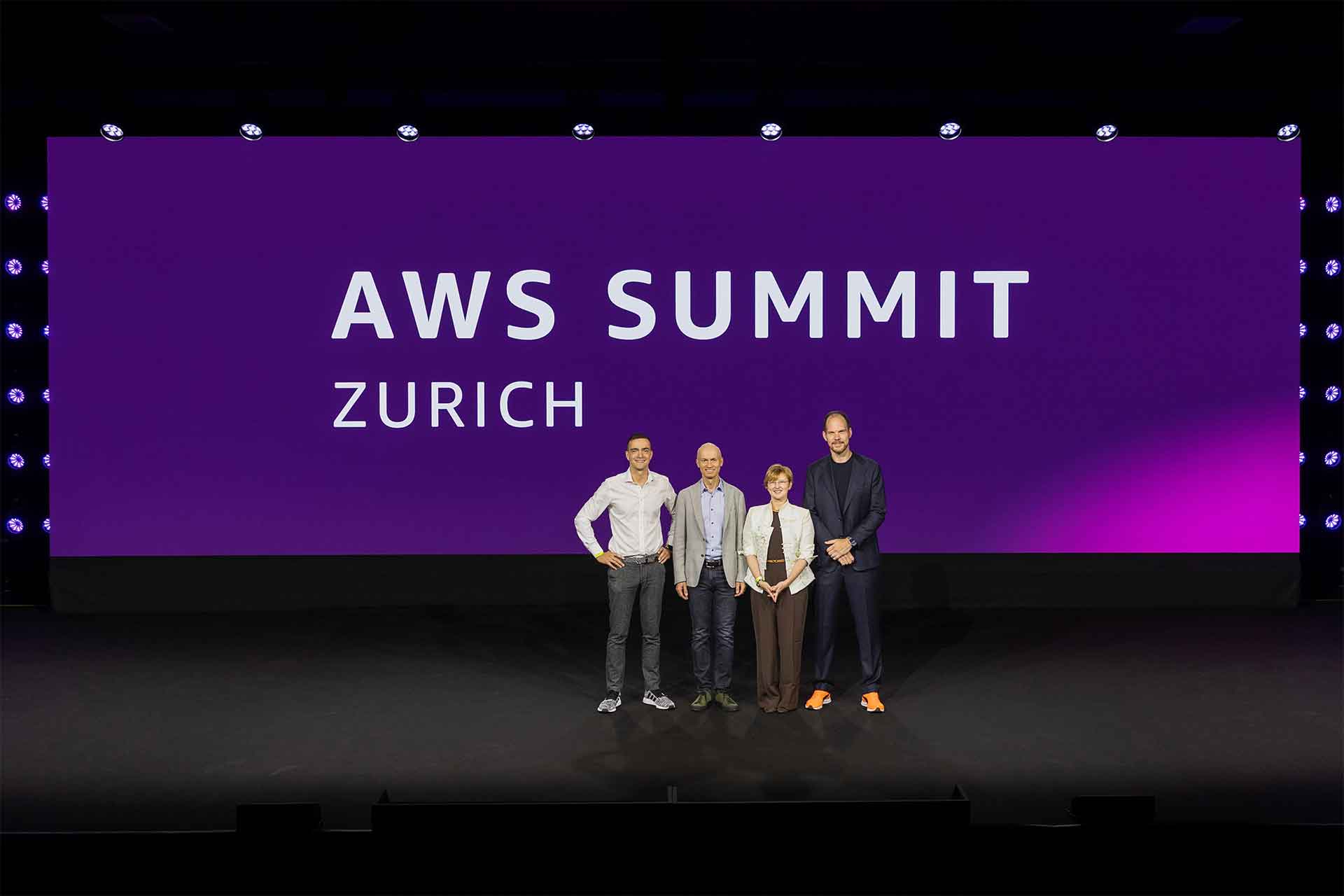
At the AWS Summit Zurich 2026, the keynote focused on the evolution of generative AI toward agent-based systems. The discussion centered not only on new technical possibilities but, above all, on their application in real-world business processes. Examples from Pictet and Nexthink show that the value of AI agents depends largely on how well they are integrated into existing data, process, and governance structures.
Meike Tarabori live from the AWS Summit Zurich 2026
“Today is the slowestday of the rest of ourlives”
With this sentence, Felix Schönherr, the newr Swiss AWS Country Manager, the AWS Summit Zurich 2026 at Messe Zürich. This statement epitomized the thematic framework of the keynote: Artificial intelligence is evolving at a rapid pace and is increasingly expected not only to provide information or support individual work steps, but also to independently take on tasks within defined processes. AWS broke this development down into several areas. Agents are intended to support daily work, assist with software development and security processes, and enable companies to build their own agent-based applications for specific tasks. For customer experience and customer service, the key question is under what conditions such systems can be effectively deployed in day-to-day business operations.
From Support to Process Automation
Rory Richardson, Director of Next Generation Developer Experience, GenAI GTM at AWS, began by addressing a well-known problem in many digital work environments. Information is scattered across emails, chats, documents, dashboards, and other applications. AI assistants can simplify access to this information, but they do not automatically solve the problem of fragmented processes. Often, it is up to the user to consolidate information, establish connections, and initiate next steps. Richardson described this limitation by saying that some existing AI assistants are ultimately little more than a slightly faster search function. Agent-based systems are designed to go beyond this. Instead of merely answering individual questions, they are intended to take a defined goal into account, draw on relevant information from various sources, and be able to execute multiple steps sequentially. Under the term “Work” , AWS demonstrated, for example, how information for a customer meeting can be consolidated from various sources and used to generate documents or trigger further actions. Under the terms “Build” and “Secure”, AWS also introduced various agent-based applications. These are intended, among other things, to support software development, modernization, and security processes. From a customer management perspective, the specific technical solution is less critical. What’s more interesting is the underlying trend: AI systems are increasingly being designed for tasks that require multiple process steps as well as access to different data sources.
Pictet: Innovation Under Regulatory Conditions
Just how closely technological development and governance are linked was demonstrated by the presentation by Martin Kunz, Group CTO of Pictet. The Swiss private bank has been using cloud and AI technologies for several years, but ties their use to clear requirements regarding security, confidentiality, and data management. Kunz clearly articulated this priority:
“Preserving our customers’ assets and their confidentiality will always come first.”
Pictet has thus built up its data and AI infrastructure step by step. A specific example from the keynote addressed the use of generative AI in investment research. A fund manager works with a universe of approximately 2,500 companies and narrows this down to a significantly smaller selection of potential investments. Research on a single company used to take a junior portfolio manager several days, but with the help of the new application, this process can now be prepared in minutes and then explored in greater depth. This case illustrates that the benefits do not depend solely on the model used. Equally crucial are the types of information a system can access, how that information is integrated, and which security and access rules apply. For regulated companies, it is precisely this combination of innovation and control that is likely to remain a key prerequisite for the broader adoption of agent-based systems.
Context Becomes a Prerequisite
Rory Richardson went on to describe another aspect of the keynote as follows: “The agents that matter most to you and your business are the ones that only you can create.” Behind this statement lies, above all, the importance of the corporate context, because a general language model knows neither a company’s specific customer relationships nor its processes, products, policies, or responsibilities. For an agent to reliably handle a task, it must be able to access relevant and, if possible, up-to-date information. Richardson summarized this as follows:
“The right answer requires context. And context lives in your data.”
This raises several practical questions for companies. What information does an agent need to perform their task? Which data sources are considered authoritative? Which systems are they authorized to access? What actions can they perform independently, and where is human approval required? Ultimately, this brings data quality, access rights, process design, and governance to the forefront alongside model selection. This is particularly relevant in customer service, as an agent-based system can only properly handle a customer inquiry if it has access to, for example, product information, customer history, contract data, process specifications, and up-to-date company knowledge. At the same time, it must be ensured that access rights are adhered to and that only the information intended for the respective process and user is utilized. Agentic AI thus increases the demands on data and knowledge management rather than reducing them. Inaccurate, outdated, or contradictory information can have a direct impact on the quality of automated decisions and responses. The more autonomously systems operate, the more important reliable data sources and clearly defined process rules become.
Nexthink: Agents for Specific Operational Tasks
Nexthink provided a second practical insight. Samuele Gantner, Chief Product Officer at Nexthink, presented the use of AI agents in IT support. The starting point is the problem of so-called “digital friction”—technical difficulties that cost employees time in their day-to-day work and place a burden on support organizations. According to Nexthink, the company processes data from more than 25 million endpoints and already employs extensive automation. The AI agent “Spark” is designed to handle some of the support cases that have been difficult to automate until now. The agent can identify technical problems, assist employees, and resolve certain issues independently. According to Gantner, Spark AI now resolves 77 percent of IT issues on the first contact. He further describes the role of AI in this process as follows:
“What AI does in this context is open up opportunities that were not possible in the past.”
The Nexthink case is interesting because it doesn’t start with the technology, but with a specific operational problem. AI is used where traditional, rule-based automation reaches its limits and additional context processing is required.
When agents become part of real-world processes
The keynote at the AWS Summit Zurich 2026 made it clear that the discussion around AI is becoming increasingly concrete. The focus is shifting away from the question of what a language model is fundamentally capable of, and toward how AI agents can be reliably integrated into real-world processes. The goal is not to deploy as many agents as possible, but rather to take the opposite approach: Which processes, customer concerns, or recurring tasks could not be meaningfully automated until now simply because they required context, interpretation, or situational decisions? This is precisely where agents can now open up new possibilities. Prerequisites for this include reliable data, clearly regulated access, defined responsibilities, and transparent guidelines regarding which tasks an agent is permitted to handle independently and where human oversight remains necessary. As a result, Agentic AI is increasingly becoming a matter of process design, customer experience, and corporate management. What matters is not where an agent can be deployed, but which relevant problem it can solve better than before. Ultimately, this will determine whether agent prototypes become productive applications with measurable added value.
AWS
Seit 2006 ist Amazon Web Services, Inc. (AWS), ein Unternehmen von Amazon.com, Inc. (NASDAQ: AMZN), die umfassendste und am weitesten verbreitete Cloud der Welt. AWS hat seine Services kontinuierlich erweitert, um praktisch jede Arbeitslast zu unterstützen, und verfügt nun über mehr als 240 voll ausgestattete Services für Rechenleistung, Speicher, Datenbanken, Netzwerke, Analytik, maschinelles Lernen und künstliche Intelligenz (KI), Internet der Dinge (IoT), Mobilgeräte, Sicherheit, Hybrid, Medien sowie Anwendungsentwicklung, -bereitstellung und -verwaltung in 105 Availability Zones in 33 geografischen Regionen, mit angekündigten Plänen für 18 weitere Availability Zones und sechs weitere AWS-Regionen in Malaysia, Mexiko, Neuseeland, dem Königreich Saudi-Arabien, Thailand und die AWS European Sovereign Cloud. Millionen von Kunden - darunter die am schnellsten wachsenden Startups, die größten Unternehmen und führende Regierungsbehörden - vertrauen auf AWS, um ihre Infrastruktur zu betreiben, agiler zu werden und Kosten zu senken. Translate automatically